
First Rate Immigrants: James & Mary Ann Milgate
Gravesend, Kent, England to Sydney, New South Wales, Australia
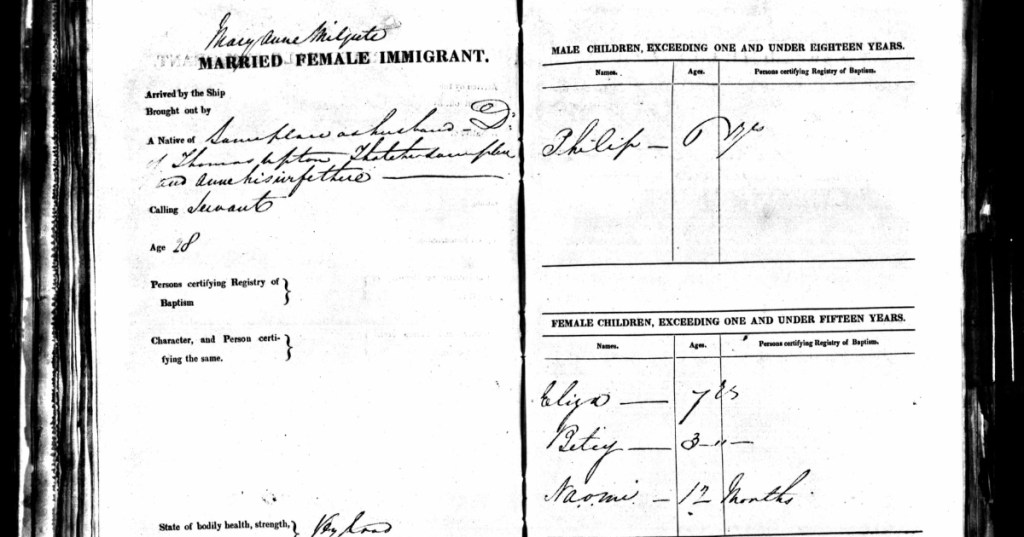
Jame and Mary Ann (nee Upton) Milgate left Beckley in Sussex, close to the border of Kent only a few miles away, leaving behind family to travel to the distant colony of New South Wales. A poignant departure having buried a daughter and son, Sarah Ann aged 8 and James aged 3 on the 4th August 1838. Life in the 1830s had been difficult for the agricultural community across the weald, so with new opportunities and government assisted support, a new life beckoned with hope for the Milgate family. James (28), a labourer, and Mary Ann (28), a servant, along with their children, Eliza (7), Phillip (6), Betsy (3) and Naomi (under 1), would embark on this treacherous journey together. Travelling on the Florist with them, Caroline (18) and Thomas Paine (21), the sister of James and her husband, married only a few weeks before on 8 June 1839 in Beckley.
The Florist passengers embarked on board the ship on 14 June, the Florist having been commissioned by the British Admiralty and placed under the care of the Surgeon and Superintendent, John Stephen Hampton Esq., serving as a member of the Royal Navy. Prior to being appointed for his first journey to Australia, Dr John Hampton had been awarded a medical diploma at Edinburgh in 1828 and subsequently entered the Royal Navy as an assistant surgeon in January 1829. After further study for the Edinburgh certificate, Mr Hampton was posted to Plymouth dockyard, where he distinguished himself in the prevention of cholera. The Medical Journal of the Florist emigrant ship from 12 June to 29 October 1839 completed by himself provides an insight to the voyage.
The Florist set sail from Gravesend down the Thames to the English Channel on 18 June, leaving the Downs behind in very heavy weather. The female passengers in particular required treatment for retching and vomiting, forcing a stopover in Plymouth to refresh the passengers from the weather and benefit from being anchored in the harbour. Only a few days into the next leg, Pertussis, commonly known as whooping cough and highly contagious, spread amongst some of the children. Generally the cases were mild and responded to treatment except for Sarah Veniss aged 3 years old, who he noted she was in poor health before departure and sadly she died at sea on 13th September. Under his care, generally the health of the passengers was good, a few cases of Infantile Fever successfully treated, a finger amputation on a child after an accident, and four babies delivered naturally over the journey. Apart from an issue with one delivery and difficulty with removal of the placenta, and preventing an early labour after a fall, the mothers and babies arrived in Sydney safely and in the “highest state of health”.
A strictly enforced system of ventilation, cleanliness and dryness, Mr Hampton believed contributed in a “very prominent degree” to the positive health of the emigrants. The cleanliness of the ship in comparison to other emigrant and convict ships was always noted and recognised during official inspections. Weather permitting, access to the deck for bathing was available at 6:30am, and the lower deck accessed at 9:00am. Breakfast was at 8:00am, dinner served at lunch and tea at 6:00pm. Evenings were filled with dancing, singing and other unharmful amusements, and the men were encouraged to actively work the ship. Bathing was permitted 3 times a week, washing on Mondays and Fridays, and clean linen on Sundays and Thursdays.
Enforcing the system of cleanliness and dryness Mr Hampton recalled it required his perseverance and quiet patience for friendly competition and rivalry exciting the emigrants in good spirit with cleaning being extended past 12:00pm after commencing at 9:00am. The surgeon concluded his report with the analysis that the emigrants arrived in Sydney in better health than when they embarked in Gravesend. Quite an insight into the health and medical treatments, along wth the daily routine followed on a 19th-century sailing vessel on its long journey.
In support of the medical journal, it was reported in The Sydney Herald the 208 Government emigrants, mostly agriculturists and a few brickmakers and mechanics, arrived in the most healthy state. With The Colonist following on the next day that the farmers from Sussex were a “first rate set”, and commending Dr Hampton’s exertions in preserving order effectually for the immigrants committed to his care. Noting the one passenger death of an infant and the suicide of crew member Benjamin Saunders during the voyage a few days prior. Before disembarkation, Governor George Gipps inspected the ship and was pleased with its state.
After a journey of many months, the Milgate family, along with Thomas and Caroline Paine left the Florist, arriving in Sydney without incident. With all other passengers, their first night back on land in this strange new country and until processed, was spent at the Immigration Barracks in Bent Street, a mixture of wooden houses and tents. On arrival James secured, and on his own account, employment near the Hunter River. James, Mary and family settled in Raymond Terrace. James died on 16 April 1869 at Raymond Terrace, a free settler of 28 years in the colony, and buried at the Pioneer Hill Cemetery. Mary Ann lived another 16 years, marrying Uriah Milham in 1876 before she died in 1885 in Lambton, New South Wales.
Florist
- Vessel: Barque
- Captain: Andrews, Phillips & Tiplady agents
- Government Surgeon and Superintendent: John Stephen Hampton Esq, Royal Navy
- Passengers: 208, T. Gore & co. agents
- Tons: 443 (Laid On)
- Tons: 530 (Arrival)
- Immigration: Free Settler, The Florist commissioned by British Admirality
- Departure:
- 12 Jun 1839 Gravesend, Kent, England
- 29 Jun 1839 Plymouth, Devon, England
- Arrival:
- 26 Oct 1839 Sydney, New South Wales, Australia
Milgate Family
- James Milgate (1810-1869), baptised Beckley, Sussex, England
- Mary Ann Milgate (1811-1885), nee Upton, baptised Iden, Sussex, England
- Marriage: 23 Feb 1830, Udimore, Sussex, England
- Children: (6 / 2 boys, 4 girls) Sarah (*DY), Eliza, Phillip, James (*DY), Betsy, Naomi
- Immigration: Government Assisted Free Settlers, Florist 1839
- Settled: Motto Farm, Raymond Terrace, New South Wales, Australia
(*DY) Died Young
Direct Descendants
- 4th Great Grandparents: James Milgate & Mary Ann Upton
- 3rd Great Grandmother: Eliza Milgate, married Thomas Adams
- 2nd Great Grandmother: Maria Elizabeth Adams, married Robert Carrall
- Great Grandfather: Robert Thomas Carrall, married Margaret Arnott
- Grandmother: Myrtle Carrall, married Laurence Mudford
- Mother: Doris Mudford, married David Green
An easily viewable Direct Line Family Tree is on DNA Painter, and my research family tree, Green Familty Tree, is on Ancestry. Search username mishleegreen via Ancestry Member Search. Michelle x
Feature Image
Ancestry.com. New South Wales, Australia, Assisted Immigrant Passenger Lists, 1828-1896 [database on-line]. Lehi, UT, USA: Ancestry.com Operations Inc, 2007.
References
- Beckley. East Sussex. Accessed 21 Apr 2025, from http://www.eastsussex.org/villages/beckley.shtml
- Florist 1839. Free Settler or Felon. Accessed 21 Apr 2025, from https://www.freesettlerorfelon.com/searchaction.php?page=1&surname=&ship=florist%201839&firstname=
- John Stephen Hampton Surgeon. Free Settler or Felon. Accessed 21 Apr 2025, from https://freesettlerorfelon.com/john_hampton_surgeon.html
- Hardy’s London Shipping List. (1839, October 2). The Sydney Monitor and Commercial Advertiser (NSW : 1838 – 1841), p. 2 (MORNING). Retrieved 21 Apr 2025, from http://nla.gov.au/nla.news-article32165757
- Shipping Intelligence. (1839, October 28). The Sydney Monitor and Commercial Advertiser (NSW : 1838 – 1841), p. 3 (MORNING). Retrieved 21 Apr 2025, from http://nla.gov.au/nla.news-article32166052
- Ship News. (1839, October 28). The Sydney Herald (NSW : 1831 – 1842), p. 2. Retrieved 21 Apr 2025, from http://nla.gov.au/nla.news-article12856055
- Shipping Intelligence. (1839, October 29). The Sydney Gazette and New South Wales Advertiser (NSW : 1803 – 1842), p. 2. Retrieved 21 Apr 2025, from http://nla.gov.au/nla.news-article2536051
- Supreme Court.—Civil Side. (1839, October 30). The Colonist (Sydney, NSW : 1835 – 1840), p. 2. Retrieved 21 Apr 2025, from http://nla.gov.au/nla.news-article31723953
- Emigrants Barracks. Dictionary of Sydney Archived Website. Accessed 21 Apr 2025, from https://dictionaryofsydney.org/building/emigrants_barracks
- Medical Journal of the Florist emigrant ship from 12 June to 29 October 1839, The National Archives. Accessed 21 Apr 2025, from https://discovery.nationalarchives.gov.uk/details/r/C4107010
- Peter Boyce, ‘Hampton, John Stephen (1810–1869)’. Australian Dictionary of Biography, National Centre of Biography, Australian National University. Published first in hardcopy 1966. Accessed 21 Apr 2025, from https://adb.anu.edu.au/biography/hampton-john-stephen-2151/text2745
 Kin Across the Seas